Cider is an alcoholic beverage made from the fermentation of apple juice. Enjoyed in different parts of the world, it is refreshing, slightly acidic, and full of history. Countries like England, France, Ireland, and Germany also produce their own versions of cider — each with its own characteristics and production methods. But when it comes to tradition and culture, few compare to Spanish cider. More specifically, Asturian cider, that is, the one produced in the region of Asturias, in the so-called cider territory, where the cities of Villaviciosa, Gijón, Nava, Lavandera, and Oviedo are located.
The Autonomous Community of Asturias is the largest producer of this beverage in Spain and the fourth largest in Europe. There, cider is not just a drink: it is a symbol of local identity. In today’s article, you will learn about the history, curiosities, varieties, and techniques surrounding Asturian cider.
The production of Asturian cider starts with the apple harvest, usually between September and November. In Asturias, there are around 500 varieties of apples. However, there are specific varieties used for producing natural cider: 76 are recognized by the Protected Designation of Origin (PDO). These have higher acidity and lower sugar content than table apples.
The fruits are washed, ground (mayanza), and pressed. The juice, called must, is then stored in large barrels, which can be made of wood (chestnut or oak) or stainless steel. From there, natural fermentation begins, a process that takes at least three months. The yeasts present in the liquid transform the apple sugars into alcohol and carbon dioxide, releasing bubbles, aromas, and flavor. Gradually, the cider becomes clearer, more stable — and more ready.
The next phase is maturation. Here, patience is essential. Asturian cider needs time, silence, and balance. During this period, the producer performs rackings, transferring the liquid from one container to another, eliminating impurities and oxygenating the beverage. Based on the aroma and taste, the cider maker knows the exact moment: that day when, without warning, the cider “wakes up” ready to be enjoyed.
Unlike other industrialized ciders, natural Asturian cider does not contain added sugar or gas. The slight fizz we feel when drinking it comes from the natural fermentation process and the traditional serving technique.
There is also sparkling cider (champagne-style cider), a more modern variation, initially created for export and today appreciated on special occasions. It can undergo a second fermentation in the bottle, as happens with champagne or cava. According to producers at LLagar El Gaitero, after 18 months, they perform a daily rotation of the bottles so the yeast settles and the cider does not become cloudy.
In addition, in some cases (especially outside the “Sidra de Asturias” Designation of Origin), some brands add carbon dioxide and/or sugar as part of the industrial process. These are the more “commercial” or industrialized ciders.
Cider (not to be confused with “cidra,” which refers to the citron fruit) is an ancient beverage, consumed since Antiquity. Hebrews, Egyptians, Greeks, and Romans already produced fermented fruit-based beverages — among them, apple. The Romans, in fact, were responsible for spreading cultivation and grafting techniques throughout Europe, including northern Spain, where the cider culture began to take shape.
During the Middle Ages, cider was common in the Basque Country. Texts from the 12th century already indicated that pilgrims on the way to Santiago de Compostela would find cider along the route. In the 14th century, the beverage began to gain popularity in Spain, especially in Asturias, where it started to rival beer in consumption.
Over time, and with industrialization at the end of the 19th century, cider ceased to be seen only as a peasant drink and was adopted by the region’s industrial bourgeoisie. Today, Asturias produces about 80% of Spanish cider and proudly celebrates its Protected Designation of Origin (2003) and the recent recognition of cider culture as Intangible Cultural Heritage of Humanity by UNESCO (2024).
Get to know the regions of Spain: communities and provinces.
Traditional natural cider is still the main star at the table, especially in Asturias. But today there are other variations that have also gained ground — each with specific characteristics and uses.
For example, natural sparkling cider has a slightly higher alcohol content and is usually present at festive moments. Table cider, or filtered cider, goes through a process that removes sediments. It is more versatile: it can be served in flutes or regular glasses and pairs very well with fish and seafood dishes from the Bay of Biscay.
Another interesting variety is ice cider (sidra de hielo), made from freezing the apple must, which concentrates flavors and sugars. Usually served in small doses, it is perfect to accompany desserts or strong cheeses.
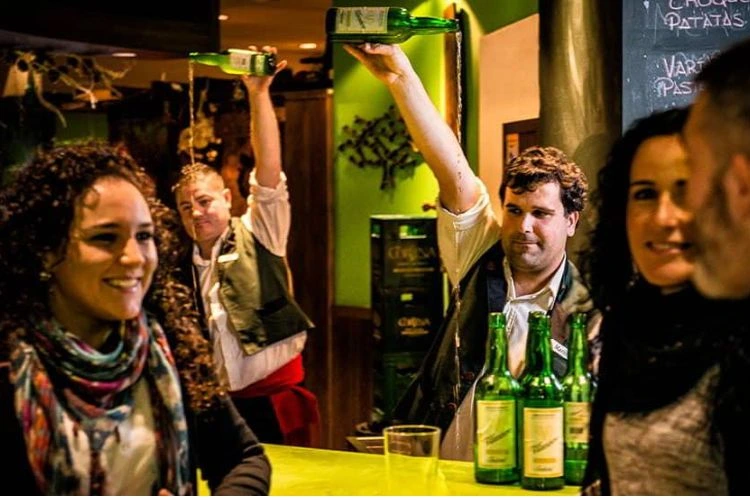
If you’ve ever seen someone pouring Spanish cider from a height, almost as if they’re missing the glass, know that it’s not clumsiness — it’s tradition. The technique is called “escanciar la sidra.”
It involves holding the bottle above the head and the glass below the waist, letting the stream fall forcefully against the inner edge of the glass. This “breaks” the cider, releasing aromas and creating natural effervescence.
This way of serving is so important in Asturian culture that, since 2024, it is an Intangible Cultural Heritage of Humanity declared by UNESCO. The ritual emphasizes immediate consumption, in small sips, right after serving.
The so-called “culín” (or “culete” in Spanish) is the small portion of the drink served in the glass, usually just two or three fingers. This is because, when poured in this way, cider releases its aromas and forms a slight natural fizziness that only lasts a few seconds. Therefore, it is tradition to drink the culín in one go, right after it’s served. The rest that remains at the bottom of the glass is usually discarded, keeping the ritual authentic. This gesture, besides being practical, reinforces the social and collective side of cider: shared, enjoyed in a group, where each sip becomes a small moment of celebration.
In Asturias, you can visit the so-called “llagares,” which are the cider-producing houses. Many of them open their doors to the public, offering guided tours on the production process, tastings, and even mini pouring courses.
Some noteworthy cider houses:
These visits are a great way to learn more about the artisanal process and the Asturians’ passion for their most iconic drink. And of course, to enjoy the beverage!
Asturian cider pairs well with local and simple foods, such as:
Moreover, although natural cider is traditionally consumed pure, there are some modern versions — mainly in Spain and Europe — that use it in light cocktails, such as:
Falling in love with Spanish culture is easy — especially with a good glass of cider in hand. And if you are thinking of living this experience permanently, Atlantic Bridge is ready to help you obtain your Spanish citizenship or the ideal visa to live in Spain.
Talk to our team and find out how to make this dream come true.