Choosing a destination goes far beyond climate and landscapes. When it comes to living or traveling in a country, understanding how urban mobility works is essential. In this regard, the public transportation system in Portugal is a cheap, safe, and efficient alternative for getting around — whether within cities, between regions, or even to neighboring countries.
The country offers an integrated and comprehensive network that combines subways, trains, buses, trams, and domestic flights. In major cities and even in smaller towns, it is possible to move around easily without relying on a car. Lisbon, Porto, and Faro are good examples of urban centers with well-structured transport systems.
In this article, we’ve gathered the main information about mobility and public transportation in Portugal: how it works, how much it costs, what the best options are for residents and visitors, and practical tips to save money on a daily basis.
And if you want to relocate to Portugal, learn about the main visas and how to apply for a residence permit in the country. Talk to our experts right now!
Yes. Portugal has an efficient and functional public transportation system that covers the entire national territory, from north to south. In the country’s two largest cities, Lisbon and Porto, there are metro networks (in Portugal, they are called metro, without an accent) — although less extensive than in other European capitals, they offer good coverage and integration with other means of transport.
In addition, the country has:
Urban transport systems are integrated, allowing metro, buses, and suburban trains to operate in a coordinated way. Most of these operations are under public or semi-public management — companies such as CP, Metropolitano de Lisboa, Metro do Porto, and CARRIS are state-owned or have government participation.
The Portuguese government has reinforced its commitment to improving mobility, making rail transport a national priority. According to the Diário da República, this investment is strategic both for territorial reorganization and for reducing carbon emissions in the sector.
Most passengers choose monthly passes, which are the most economical way to travel daily. It is estimated that around 80% of public transport users follow this fare model, which also encourages continuous use of the system.
Portugal is becoming a very attractive destination, not only for tourists but also for expats looking to start a new life in the country. In 2024, 245,900 commercial aircraft landed at Portuguese airports, representing a 0.9% increase compared to 2023.
Portugal has 10 airports:
Airports on the mainland:
Airports on the islands (Autonomous Regions):
All are operated by ANA – Aeroportos de Portugal, with connections to Europe, the Americas, and Africa.
In Portugal, trains are known as “comboios.” The rail system is operated by Comboios de Portugal (CP) and connects various cities and regions of the country. Most trips take place between 6 a.m. and 11 p.m., but there are also some overnight journeys. There are different types of trains, suitable for each type of route:
Therefore, within a Metropolitan Area, it is perfectly possible to use urban trains to reach nearby cities and towns. For example, from Porto, you can travel to places like Ermesinde, Espinho, São Bento, Vila das Aves, Valongo, among others, without needing a regional bus.
These connections are integrated into the Andante fare system — meaning you can use the same Andante card that you use for the metro or bus, at no extra cost.
Prices vary depending on the train category, chosen class, and how far in advance you purchase the ticket. Some examples of costs:
| Origin | Destination | Average Duration | Price (from) |
|---|---|---|---|
| Lisbon | Porto | 2h50 (Alfa Pendular) | €21 |
| Lisbon | Cascais | 1h30 | €2.45 |
| Lisbon | Coimbra | 1h45 | €10 |
| Lisbon | Évora | 1h30 | €7.50 |
| Porto | Braga | 1h | €3.55 to €22.60 |
| Porto | Aveiro | 50 min | €3.90 |
| Porto | Ermesinde | 20 min | €1.60 |
| Coimbra | Figueira da Foz | 1h15 | €3.05 |
Yes, there are some railway connections between Portugal and Spain, but they are still quite limited. See the main ones:
This is currently the main international train connection. The Celta Train runs daily between Porto – Campanhã and Vigo, in Galicia, in about 2h20. It stops in Nine, Viana do Castelo, and Valença. Tickets cost from €7.30, and the trip is comfortable, with beautiful views of northern Portugal. Tickets can be purchased on the CP or the Spanish Renfe website.
CP offers tickets from Lisbon to Badajoz, but you need to make a connection at Entroncamento, using regional services. The trip takes between 4 to 6 hours, depending on the service (number of stops). Despite the train change, it is a viable option for those wishing to reach western Spain. Tickets start at €16.
The train link from Lisbon to Madrid is an old project now finally under construction. The high-speed line is advancing in stages, and the first stretch (Évora-Elvas) is expected to open in 2025. Once completed, the new line will connect the two capitals in under 3h30. The final completion is expected by 2034, placing Portugal on the high-speed rail map of the Iberian Peninsula. Today, the best option to travel between the two cities is still…
The trams, known as elétricos in Portugal, are a true national symbol, contributing to the historical charm of cities like Lisbon, Cascais, and Porto. Since the inauguration of the first line in Lisbon in 1901, they have become an essential part of the urban landscape and mobility.
Today, these trams not only preserve the charm of the past but continue to operate, connecting important and touristic spots in the cities.
Although they are clearly a tourist attraction, trams are also part of the daily routine for residents, especially in Lisbon, where they remain a practical alternative in areas that are difficult for cars to access. Besides being functional, they offer a unique and panoramic way to explore historic centers with charm and authenticity.
In terms of pricing, in Lisbon, a single ticket costs €3.20, while the integrated daily pass, which allows travel on various means of transportation, is €7. In Porto, the single ticket costs €3.50, and the monthly pass, which includes integrated transportation, is available for €40.
Traveling by bus across Portugal is one of the most economical and practical ways to get to know the country. Companies such as Rede Expressos and FlixBus operate routes between the main cities and even abroad, with fares starting at €2.95, depending on the route and how early the ticket is purchased.
A trip from Lisbon to Porto, for example, can cost as little as €3.95.
In addition to being comfortable and punctual, many of these buses offer air conditioning, Wi-Fi, and power outlets on board. Another advantage is that several companies also offer international routes, especially to Spanish cities such as Vigo, Seville, and Madrid. It’s the ideal option for those who want to explore Portugal and the rest of Europe on a budget.
A fun fact: buses in Portugal, even municipal ones, do not have fare collectors. The fare is either validated automatically on the machine or paid in cash directly to the driver.

Lisbon is the best-served city in terms of transportation. With around 550,000 inhabitants in the city and over 2.8 million in the metropolitan area, the capital has a broad, modern, and integrated system.
Humberto Delgado Airport is just 8 km from the city center and connected to the metro (Red Line). It has daily flights to major European destinations, as well as to the Americas and Africa. About half of all flights in Portugal (49%) go through this airport, which is the country’s main air hub.
Lisbon has several stations integrated into the urban and metropolitan system. Within the city, four main stations stand out:
In the metropolitan region, there are dozens of other stations, such as Cacém, Sintra, Oeiras, Almada, and Barreiro, which facilitate the daily commute of thousands of passengers. Ticket prices vary depending on the route — for example, Lisbon–Sintra starts at €2.30 — and the monthly Navegante Metropolitano pass, which covers all regional transport, costs €40. The network is mainly operated by Comboios de Portugal (CP), offering urban, regional, intercity, and Alfa Pendular trains, the fastest and most comfortable option.
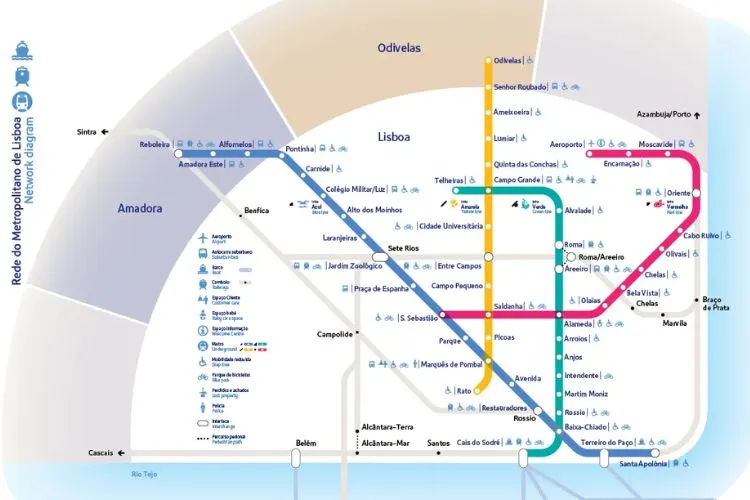
Inaugurated in 1959, the Lisbon metro is the oldest in the country and one of the main transportation options in the capital. Although smaller than the Porto metro, with 4 lines and 58 stations, it is one of the fastest and most efficient ways to get around the city. The system includes both underground and above-ground segments and extends to neighboring municipalities in the Metropolitan Region, such as Amadora, Loures, Odivelas, and Oeiras.
The single ticket costs €1.85 and is valid for 60 minutes, allowing travel on different modes of transport, such as metro and bus. For frequent users, the monthly pass is included in the Navegante card, which can also be loaded with occasional travel titles.
Ticket validation is done using the Viva Viagem or Navegante cards, both required for travel. The Lisbon metro is the best way to explore the city and its main attractions, such as Humberto Delgado Airport and the historic center. For example, the journey from Baixa-Chiado to the airport takes only 25 minutes.
Lisbon’s buses (autocarros) are an essential part of the city’s public transport system. Operated by Carris, the city’s main transport company, the buses cover a vast network of routes, connecting various neighborhoods, suburban areas, and important tourist spots. There are more than 700 lines across the entire city. The routes range from central areas such as Baixa and Chiado to more distant neighborhoods like Parque das Nações.
By accessing the Carris website, it is even possible to check routes for your desired trip, as well as estimated travel times and the full path taken.
In addition, the buses have an important advantage: the waiting time between buses is usually not too long, with average intervals of 20 to 40 minutes between trips, depending on the area and time of day. During peak hours, frequency increases, ensuring that passengers don’t have to wait too long to board.
The single ticket price is €2.20, but the fare can be reduced to €1.66 if the passenger uses the Viva Viagem card, which can be loaded with credits or daily, weekly, or monthly passes. The Viva Viagem card allows integration with other modes of transport in the city, such as the metro and tram (elétrico), making travel more economical and convenient.
The updated fare table valid in 2025 is available [here] and summarized below:
Public Transport Prices in Lisbon
| Ticket Type | Price (€) |
|---|---|
| Carris/Metro Ticket (1h on the network) | 1.85 |
| Bus (1 trip, bought onboard) | 2.20 |
| Tram (1 trip, bought onboard) | 3.20 |
| Bica, Glória and Lavra Funiculars (up to 2 trips) | 4.20 |
| Santa Justa Lift (up to 2 trips + viewpoint) | 6.10 |
| Carris/Metro Day Ticket (24h) | 7.00 |
| Occasional Navegante Card (paper) | 0.50 |
| Municipal Navegante Pass (monthly) | 30.00 |
| Metropolitan Navegante Pass (monthly) | 40.00 |
In addition to these rates, Lisbon’s public transport system offers free or discounted fares for youths under 23, war veterans and their widows/widowers, as well as special conditions for families, such as the Navegante Família. Passes are also available at reduced rates for pensioners and residents over 65 years old, benefiting those who rely most on public transportation in their daily lives.
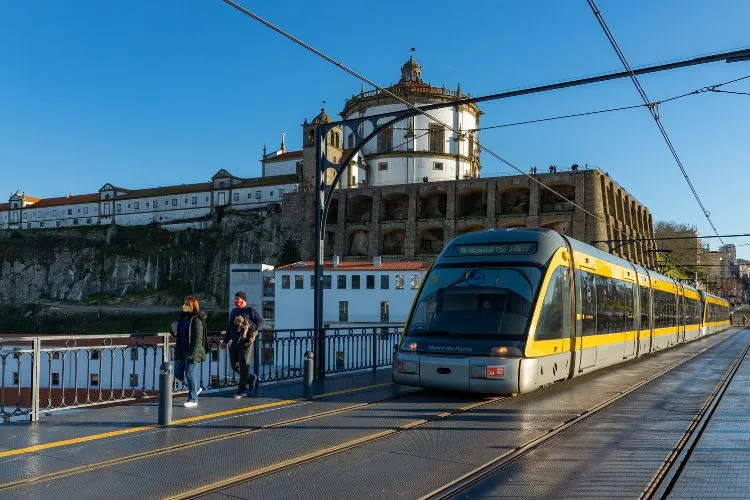
With 230,000 inhabitants and over 1.7 million in the metropolitan area, Porto also has an efficient, integrated, and modern transportation system. Interestingly, the region with the best road and rail accessibility indexes in the country is the Porto Metropolitan Area, according to a study by the Manuel dos Santos Foundation.
Francisco Sá Carneiro Airport, in Porto, is the second largest in Portugal in terms of passenger volume, second only to Lisbon Airport. Located about 11 km from the city center, between the municipalities of Maia, Matosinhos, and Vila do Conde, it operates domestic and international flights to various destinations. Furthermore, in 2024, it handled approximately 15.9 million passengers. It is a hub for TAP Air Portugal and an important base for airlines such as Ryanair, EasyJet, and Transavia France.
Porto has two major railway stations: São Bento and Campanhã. São Bento Station, located in the heart of the city, is considered one of the most beautiful in Europe, famous for its tile panels depicting scenes from Portuguese history.
Suburban trains connect Porto to several cities in the north of the country, such as Braga, Guimarães, Aveiro, and Espinho, facilitating daily travel for work, study, or tourism.
Ticket prices vary depending on the zones traveled. The system is integrated with the Andante card, allowing combined use with metro and bus. The monthly pass, which covers the entire Porto Metropolitan Area, costs €40 and is a very advantageous option for frequent public transport users.
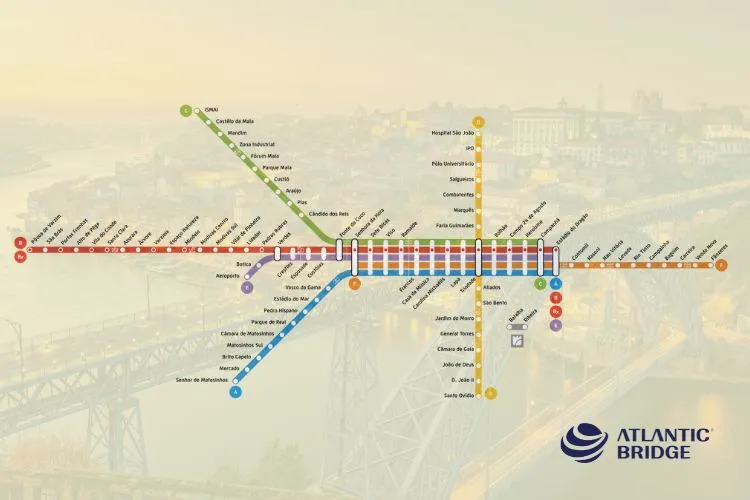
The Porto Metro was inaugurated in 2002 and is now one of the most modern transportation systems in Portugal, with direct connections to the airport, the historic center, and cities like Vila Nova de Gaia, Matosinhos, Maia, and Póvoa de Varzim. It consists of 6 lines and 81 stations, combining underground sections — mainly in the city center — with surface segments that serve suburban areas and neighboring cities.
Fares vary depending on the distance traveled, with the most basic ticket starting at €1.40 (zone Z2). All tickets are valid for 1 hour, allowing transfers within the same fare zone. The use of the Andante card is mandatory to validate trips. It can be loaded with occasional tickets or with a monthly pass.
An interesting feature is that the Porto Metro has no turnstiles, which speeds up passenger flow. However, inspections are frequent and strict. Inspectors patrol the trains and stations, and anyone caught without a validated ticket is subject to fines that can exceed €100. Therefore, it is essential to validate the ticket before boarding.
In Porto, the bus system is operated by STCP (Sociedade de Transportes Coletivos do Porto), which manages 71 bus lines, with 58 daytime lines operating from 6:00 a.m. to 12:30 a.m., and some night lines providing 24-hour service every day of the year.
Urban bus fares vary depending on the zone traveled and the method of payment. A single ticket purchased directly from the driver costs €2.50, but when using the Andante card, the price drops to €1.40 (zone Z2) or €1.80 (zone Z3). All tickets are valid for 1 hour, and the bus system is integrated with other modes of transport such as the metro and suburban trains, making it easier to move around the Porto Metropolitan Area.
| Ticket Type | Zone/Option | Price (€) | Duration/Validity |
|---|---|---|---|
| Bus trip (purchased from the driver) | All lines | 2.50 | Valid for one trip |
| Bus trip (with Andante Card) | All lines | 1.40 | Up to 1h00 |
| Metro trip – short distances | Z2 / Z3 | 1.40 / 1.80 | Up to 1h00 |
| Metro trip – long distances | Z8 / Z9 | 4.10 / 4.55 | Up to 2h15 / 2h30 |
| Paper Andante Card (occasional) | – | 0.60 | Rechargeable |
| 24-hour trip (Andante Tour 1) | Entire network | 7.50 | 24 hours |
| 72-hour trip (Andante Tour 3) | Entire network | 16.00 | 72 hours |
| Andante Intermodal Pass – Municipal | Standard | 30.00 | 30 days |
| Senior | 22.50 | 30 days | |
| Andante Intermodal Pass – Metropolitan | Standard | 40.00 | 30 days |
| Senior | 30.00 | 30 days |
Faro, the capital of the Algarve, is a coastal city with around 65,665 inhabitants. Although it does not have a metro network, it offers a public transport system appropriate for its size, including urban buses, rail connections, and an international airport.
Faro International Airport is the third busiest in Portugal, behind only Lisbon and Porto airports. In 2024, it recorded 9.8 million passengers, representing a 2% growth compared to the previous year. Located about 6 km from the city center, it is a crucial infrastructure for the region.
Rail transport in Faro is simple, practical, and ideal for those wishing to explore the Algarve or travel to Lisbon. The city has two stations — the main one is Faro Station, close to the center and with access to Intercidades, Alfa Pendular, and Regional trains from Comboios de Portugal (CP); the second is Bom João stop, mainly used by regional trains. The main operating line is the Algarve Line, connecting Faro to Lagos in the west and Vila Real de Santo António in the east. The train journey from Faro to Lisbon takes about 3h30, and tickets are available online or at the ticket office.
No. Transportation is provided by buses and trains.
In Faro, buses are a practical and economical way to travel both around the city and to the region’s beaches. Its public transport is operated by two main companies:
With beautiful landscapes and good public transport coverage, it is possible to enjoy the Algarve by bus — without worrying about parking or traffic. Download the zone and bus line map here.
Portugal offers several useful applications for public transport users, making it easier to plan routes, check schedules, and even purchase tickets.
CP – Comboios de Portugal has its own app for buying train tickets and viewing real-time schedules. In Lisbon, Carris offers an app with bus location and waiting times. In Porto, STCP has an app with updated information on the city’s buses.
For transport integration and card management, the Anda app (replacing the physical Andante card in Porto) and Navegante app (in Lisbon) allow users to check balances, top up cards, and view itineraries. The Carris website allows users to check updated fares for municipal buses and trams in Lisbon. Meanwhile, the Portal Viva is useful for visitors and occasional users of public transport in the capital.
In addition, apps like Moovit and Citymapper work in several Portuguese cities and are ideal for planning routes that combine metro, bus, train, and even bikes or scooters.
To rent bikes and scooters, try Bird or Bolt, which can also be used to call a taxi.
Although Portugal doesn’t have as extensive a public transport network as some other European countries like Switzerland, its available system is well-organized and efficient. With modern vehicles, punctual services, and digital platforms offering detailed information about routes, schedules, and fares, it’s perfectly possible to live and get around easily, even without a car—especially in major cities. Moreover, for those coming from countries like Brazil, this infrastructure represents a significant improvement in terms of accessibility, comfort, and efficiency.
And more: public transport is just one of the many positive aspects that make Portugal an extremely attractive destination to live in. On our blog, we’ve already covered topics like safety, climate, cuisine, education, and public healthcare—and it’s the combination of these factors that should guide your decision to move.
If you are considering relocate to Portugal, contact Atlantic Bridge and count on full advisory support to turn this plan into reality.