June 10th is celebrated as Portugal Day and is a national holiday across the country. The date marks the death of Luís Vaz de Camões, one of the greatest figures in Portuguese literature and author of Os Lusíadas. But the celebration goes beyond that. It also honors Portuguese communities abroad, the Portuguese language, national identity, and the Armed Forces. Inspired by the occasion, we’ve gathered a bit of history and some curiosities about Portugal’s most iconic national symbols.
The choice of June 10th as Portugal Day has historical and political roots. It was officially declared a national holiday during the Estado Novo dictatorship, when it was known as “Day of the Portuguese Race” — a date used to promote national pride and the idea of a people united by language and culture, spread across the world.
After the Carnation Revolution (Revolução dos Cravos) and the fall of the dictatorship, the celebration took on new meaning. In 1978, the date was officially renamed Portugal Day, Camões Day and the Day of the Portuguese Communities, paying tribute not only to the poet who embodies national identity, but also to Portuguese citizens living abroad.
Today, the day is marked by official ceremonies, speeches, and tributes. The President of the Republic typically presides over the events, which include military parades, award ceremonies, and celebrations held in Portuguese communities around the globe.
Want to move to Portugal? Find out how!
Take a look at some of Portugal’s most iconic national symbols…
No food is more quickly associated with Portuguese identity than cod, which is present in many typical local recipes. But where does this relationship come from?
Since the Middle Ages, a lot of cod has been consumed in this region, much of it imported from Northern Europe. The claim that the codfish would have become popular because it was used on sea expansion voyages is taken as a legend by scholars. However, it is known that dried salted codfish, because it is easy to preserve, was seen as a solution for the days of fasting and abstinence imposed by the Catholic religion. Despite having an immense coastline, the difficulty of supplying fresh fish to the populations was a reality.
Initially consumed only by the wealthiest classes, cod became popular in the 19th century, with the creation of policies to promote national production of the product. Later, during the Estado Novo regime, the protectionist model of the codfish industries led to a relevant codfish production that lasted until the fall of the regime in the 1970s.
Known as a “faithful friend”, rich in Omega 3 and Vitamins A, D and B12, cod is more nutritious than fresh fish, thanks to the methods by which it is salted. Despite the decline of Portuguese production, cod is still very present in the country’s diet. It is estimated that Portugal consumes 20% of the cod caught in the world, which represents 70,000 tonnes of salted cod peryear (an average of seven kilograms ‘per capita’).
Born in the popular contexts of 19th century Lisbon, this typically Portuguese musical style was considered intangible heritage of humanity in 2011, marking forever its cultural importance.
At first, it was associated with the more marginal spheres of society, sung on the streets and in places frequented by prostitutes, sailors, and rowdy individuals. Gradually, it was absorbed by the revista theater, and started to be sung by famous actresses and renowned fado singers, accompanied by the Portuguese guitar. In the 40’s and 60’s, Fado had its golden years, being played on the radio, in the movies and on television, already through professional Fado companies.
There are still those who question the origin of Fado. The scholar José Alberto Sardinha defends that the style descends directly from romance, whose origin dates back to the Middle Ages. There are those who consider that Fado was brought to Brazil by African slaves and adapted from a West African dance. Others consider that it was developed from a lament song of Portuguese sailors. The word Fado possibly comes from the Latin word “fatum”, from which also comes the English word “fate“.
What is certain is that this musical style has become very present in Lisbon’s historic neighborhoods, especially in Bairro Alto and Alfama. It won over the world in the voice of Amália and currently boasts a new generation of representatives, led by the talent of singers like Mariza, Camané, Ana Moura, among others.

Azulejos (glazed tiles) are used in many countries, including Spain, Italy, Turkey, and Morocco. So why is Portugal considered the tile capital of the world? The answer lies in tradition: for over 500 years, Portugal has used azulejos on building façades, interiors, and public spaces almost without interruption — and in truly remarkable quantities.
Glazed ceramic tiles with geometric patterns have been present in the Iberian Peninsula since the time of Islamic rule (from the 8th to the 13th century), including areas that are now part of modern Portugal. However, it was around the year 1500 that azulejos began to play a central role in Portuguese aesthetics. This shift came thanks to King Manuel I, who, after visiting Andalusia, was fascinated by the Hispano-Moorish tilework and decided to bring the tradition to Portugal. One of the first buildings to feature them was the National Palace of Sintra.
From that point on, the use of azulejos spread widely and developed its own unique style. The iconic blue color so often seen in Portuguese tile panels was inspired by Chinese porcelain, which was highly prized at the time. Beyond their beauty, the tiles also served a practical purpose: they protected walls from humidity and cold, offering long durability at a relatively low cost. And churches used them as a way to tell stories of saints and make biblical accounts.
The immense quantity of tiles in Portugal also owes a lot to the so-called “Masters’ Cycle”, when a large investment was made in the training of local artists, who started producing them on a large scale. Finally, during the dictatorship, the tile became a national and economic status symbol, being spread all over the country.
There are beautiful examples of tiled walls in Portugal. The São Bento train station in Porto has over 20,000 tiles and has been considered by numerous renowned publications (such as The Guardian and Condé Nast Traveler) as one of the most beautiful in the world.

A rather curious story surrounds the invention of the famous Pastel de Nata (the Portuguse Custard Tart), also known worldwide as Pastel de Belém. This is one of the most iconic specialties of Portuguese conventual sweets.
As the name suggests, conventual sweets began being produced in convents starting in the 15th century. Egg whites were commonly used as a clarifying agent in white wine production and to starch the garments of wealthy men and priests. As a result, there was a surplus of egg yolks, which were then used to make sweets, along with sugar produced in large quantities in the colonies.
When religious orders were dissolved in Portugal in 1834, female convents were allowed to remain open until the last nun passed away. During this period, convents began selling their sweets to the public. Some nuns sold their recipes to local pastry shops.
The Pastéis de Belém were created at the Jerónimos Monastery and, starting in 1834, began to be sold next to the monastery at the Pastelaria de Belém, which is believed to hold the original recipe. The name Pastel de Belém can only be used by this pastry shop. Outside of it, the sweet is known as Pastel de Nata. Check out our full article on Portuguese cuisine!

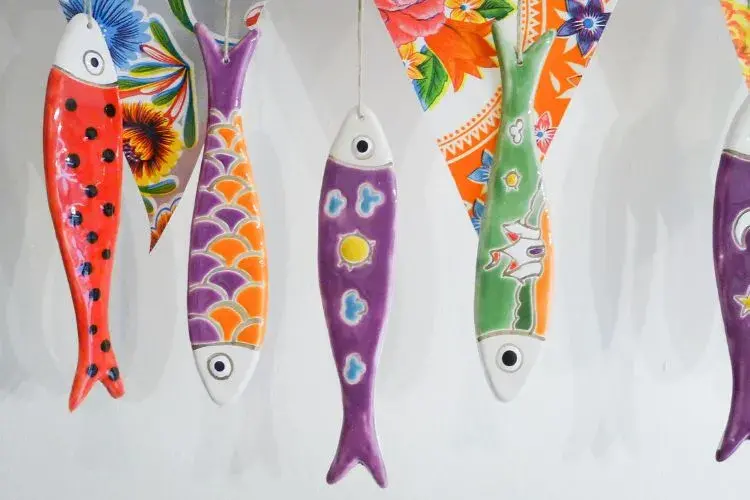
The sardine is an abundant fish on the Portuguese coast and is highly appreciated by the local community, especially during the summer. It is delicious when prepared over charcoal and is very present in the Portuguese popular saints’ festivities: Saint Peter, Saint John and Saint Anthony. Very nutritious, it has the power to improve cholesterol levels, reduce high blood pressure and minimize the risks of cardiovascular accidents, and can be included in the daily menu.
At the beginning of the 17th century there was a shortage of sardines in Portugal. That’s when the idea of eating the fish with bread came up.
Consumption in the canned version began at the end of the 19th century and within a few decades Portugal became the world’s biggest exporter in this sector. It is estimated that in 1925 there were already 400 different canned sardine factories in the country, 50 of them in the small town of Matosinhos, in the district of Porto. Today there are only 15 of them, with strict quality control and high productivity. They export all over the world.
➡️ 🐟 Fun Fact: Tinned sardines were widely consumed, particularly during the Second World War, to feed soldiers from both sides of the conflict. In the 1950s, the management of the Ramirez company was informed that three tins of sardines in olive oil of that Portuguese brand had been found in Hitler’s former bunker. Six years later, their contents were perfectly edible with their flavor intact. The producers argue that the preserves have a high durability and some say they are like port wine: they get better with the passing of the years.
Want to visit a traditional Portuguese sardine factory, see the production process up close, and enjoy a tasting paired with a DOC wine? Book your experience with our partners at Portugal Experiment!
On 10 September 1756 the Marquis of Pombal created the oldest demarcated wine region in the world: Douro Vinhateiro, the region where the grapes used to produce this Nectar of the Gods come from! In 2001, the region was classified by Unesco as a World Heritage Site.
Port Wine is sweet and strong, as the fermentation of the grapes is not complete and is interrupted after two or three days with the addition of grape brandy. It has four main categories: White, Ruby, Tawny and, more recently, Rosé.
English producers guarantee that it was British merchants who created Port Wine, adding brandy to ordinary wine to prevent it from going sour. The Portuguese, on the other hand, say that the technique was used long before, at the time of the Discoveries. Regardless of the authorship, it is known that it was the English who made the drink famous worldwide.
Learn how to get Portuguese Citizenship
Most tourists who visit Portugal don’t return home without acquiring the country’s most famous symbol: the red-crested black cockerel. It is sold in many shops in various formats: as a handicraft, usually in clay or metal, or as souvenirs (fridge magnets, aprons, tablecloths, dishcloths…).
Such popularity inevitably leads us to the question: how did this association begin?
The fame of the Rooster of Barcelos originated from a legend. In medieval times, a crime was committed in the city of Barcelos that no one could solve. A young Galician pilgrim, passing through the region on his way to Santiago de Compostela to fulfill a vow, was accused by the townspeople. As a result, he was sentenced to be hanged. The young man swore he was innocent and requested an audience with the judge. The meeting took place at the judge’s home, during a banquet. There, he reaffirmed he had committed no crime, but was ignored. In the face of such indifference, he pointed to a roasted rooster on the banquet table and declared:
“It is as certain that I am innocent as it is certain that this rooster will crow when I am hanged.”
Nobody took the boy seriously, however, at the time of the hanging, the Portuguese rooster stood up and crowed! The judge went to the gallows to try to prevent the injustice and arrived in time to see the boy survive because of a badly tied knot in the rope. Released and acquitted, the Galician returned years later and built, on the spot where the gallows had stood, the Cruzeiro do Senhor do Galo, in praise of the Virgin Mary and Saint James. The monument is located in the current Paço dos Condes de Barcelos, in the old city of Barcelos, in northern Portugal.
Curiously, the popularization of this symbol also happened during the dictatorship. António Salazar, who was in charge of the country until 1970, bet on the rooster as a representative of Portugal’s folklore in international tourist fairs and made the rooster official as a national symbol.
Filigree is an artisanal goldsmith’s technique that consists in creating delicate patterns and designs from the combination of fine gold or silver threads. This exquisite art has its origins in the Iberian Peninsula, dating back to the Roman occupation period. However, it was in Portugal that filigree gained greater development and notoriety over the centuries.
Filigree is applied to many types of jewelry, such as earrings, necklaces, bracelets, and rings. In addition, it can be found in decorative objects, cutlery, and pieces of furniture. This ancient technique is one of the main symbols of Portuguese art and tradition. It represents the mastery and talent of Portuguese craftsmen, passed down from generation to generation.
Check out our full article on filigree and Portuguese jewelry!
Rich in history and culture, Portugal has many national symbols that cannot fit on a list. We list the most frequently mentioned here, but there are many other icons, personalities, monuments, knowledge and flavors that cannot be forgotten.
It is also worth mentioning:
Swallows – the ceramic version is present in the decoration of many Portuguese homes because it symbolizes love, fidelity and the arrival of spring (the time when they arrive in the country in search of food and warmth).
Cork – important national export product used for the manufacture of corks and other products.
Olive oil – Portugal is the sixth largest producer in the world, but uses this liquid gold in almost all typical recipes.
Cross of Christ – stamped on the caravels of the great navigations, it is also closely linked to the Portuguese.
Lenço dos namorados (Lovers’ handkerchief ) – typical of the Minho region and embroidered by women of marriageable age.

Among the monuments, special attention goes to the Torre de Belém (in Lisbon) and the Ponte Luiz I (in Porto), images that are constantly printed on souvenirs. In literature, we can mention Camões, Fernando Pessoa, José Saramago, Florbela Espanca. In sport, we have the football star, Cristiano Ronaldo. In architecture, we highlight the importance of Siza Vieira. In science, António Damásio. In history, names like Vasca da Gama, Pedro Álvares Cabral and Dom Pedro I. In the arts, Alexandre Farto, known as Vhils.
It’s no wonder that Portugal wins over expatriates so quickly, as the cultural codes contribute to the construction of bonds and affective memories. Have we forgotten anything on this list?
Come and live in the country in all its essence! If you wish to relocate to Portugal, study or invest in the country, talk to one of our consultants!
Atlantic Lovers* is a special edition of Atlantic Bridge whose mission is to integrate our clients, friends and partners around the best that Portugal has to offer.
*Silvia Resende is marketing manager at Atlantic Bridge. From Bahia, she arrived in Portugal in 2015 to build a new life with her family. She has a degree and a master’s degree in Communication Sciences and has worked as a TV presenter, event producer, public relations, copywriter and tour guide in Porto. She loves to travel and to discover the cultural heritage of each place she goes. And she loves to write about the cultural richness of Portugal!