Moving to Portugal has become an increasingly common dream among people seeking a significant and positive change in their lives. Thanks to its quality of life and safety, the country is considered one of the best places in the world to live. Portugal ranked third in Europe—behind only Spain and Cyprus—in the Expat Insider ranking.
The country has also gained recognition in several international media outlets and received numerous awards in the tourism sector, increasing people’s desire to establish residence there. If you can also imagine yourself moving to Portugal, keep reading this article.
Here, we explain all the main routes available for your move. You will see that moving to Portugal can be much easier than you might think!
To move to Portugal you will need to have Portuguese citizenship, european citizenship or a residence visa. Citizenship offers a direct way of establishing permanent residence.
Alternatively, a residence visa allows you to stay in the country for a specified period and can be renewed.
We strongly recommend that you do not do this. Portugal has made it increasingly difficult to regularize an immigration status from within the country.
Avoiding an irregular immigration situation is essential, as it may result in deportation, fines, and difficulties obtaining legal status in the future. You may also face restrictions in accessing healthcare services and legal protections, as well as difficulties working legally. This can limit your opportunities and income. To avoid these problems, make sure you have the appropriate documentation.
Tourists may generally remain in the country for up to 90 days. In some cases, it may be possible to extend a tourist stay for another 90 days, but this is not necessarily a simple process. Therefore, anyone who wishes to stay for a longer period should consider safer and more appropriate alternatives.

Moving to Portugal is considerably simpler for Portuguese citizens. In terms of documentation, you will generally only need a Portuguese passport or another document proving your citizenship, such as a Portuguese Citizen Card.
To live in the country, you should also obtain a NIF, which is your Portuguese tax identification number, a national healthcare SNS user number and a NISS, which is your Social Security identification number.
The following people may be entitled to Portuguese citizenship:
We have a comprehensive article about obtaining Portuguese citizenship, including the necessary documents and expected processing times.
Anyone who holds citizenship from another European Union country may also legally reside in Portugal. This is possible because of the European Union’s freedom of movement rules.
However, residence must be formally registered in Portugal by obtaining a CRUE, the Registration Certificate for European Union Citizens.
You may also move to Portugal with a residence visa. A residence visa is a legal authorization granted by a country that allows a foreign national to live and work temporarily within its territory.
Portugal offers different visas for different applicant profiles, including:
Each category has its own specific requirements, but most applicants must provide proof of sufficient financial resources, health insurance, a clean criminal record, and accommodation in Portugal.
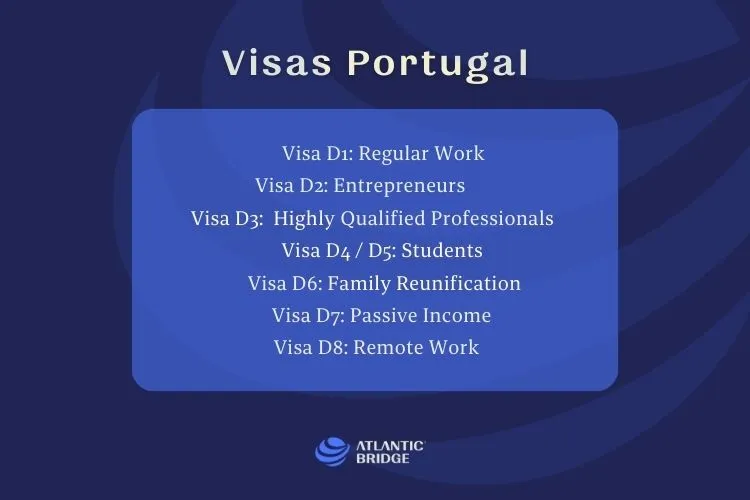
There are three particularly common routes for people who wish to move to Portugal.
The D7 Visa is one of the most popular residence visas in Portugal. Although it is commonly known as the Retirement Visa, it is intended for people with different forms of passive income, including:
The financial requirements for the D7 Visa are relatively straightforward and attractive. Applicants must demonstrate monthly income above the equivalent of one Portuguese minimum wage and hold an amount equivalent to 12 Portuguese minimum wages in a Portuguese bank account.
The applicant must also have a clean criminal record, without convictions for offenses punishable in Portugal by a prison sentence of more than one year, regardless of whether the sentence was served.
Learn everything about the D7 Visa.
Another highly sought-after option is the D8 Digital Nomad Visa. It is ideal for people who work remotely and is available to both employees and self-employed professionals.
The minimum income requirement corresponds to four times the Portuguese minimum wage. Under this route, depositing funds in Portugal is not mandatory for the visa application, but it is highly recommended when applying for the residence permit.
Applicants must also have a clean criminal record, without convictions for offenses punishable in Portugal by a prison sentence of more than one year, regardless of whether the sentence was served.
Learn everything about Portugal’s Digital Nomad Visa.
Regardless of your age, studying may be one of the easiest and most affordable ways to obtain a residence visa for Portugal.
Consider completing a master’s degree or doctorate at a Portuguese university. In addition to strengthening your résumé, this route allows you to meet new people and build a strong connection with Portuguese culture. There are also interesting options for people who do not speak Portuguese.
To obtain a student visa, however, you must first be accepted by a university.
The process is straightforward. Visit the university’s website, choose a course, and submit your application with your professional résumé, motivation letter, and academic records.
Selection is usually based on the applicant’s academic and professional background, as well as their performance in a video interview. After being accepted, you may apply for the student visa.
Learn how to apply for a student visa in Portugal.
After entering the country with the appropriate visa, the next step is to apply for a temporary residence permit.
After five years of continuous renewals, it may be possible to apply for permanent residence or long-term resident status.
The main difference is that the permanent residence permit is issued specifically for Portugal, while long-term resident status is recognized throughout the European Union.
Portugal has a broad family reunification process that may include spouses or partners, children and, in certain circumstances, financially dependent parents and parents-in-law.
There are two main ways to move with your family.
The first is to submit the visa applications together, allowing everyone to travel to Portugal at approximately the same time.
The second is for one family member to move first and subsequently apply for family reunification in Portugal for the remaining relatives.
In the second situation, it is important to understand the rules established by Portugal’s Immigration Law. Depending on the family relationship and the resident’s status, it may be necessary to wait for a certain period before beginning the process. Minor children, however, are among those who are not subject to this waiting period.
For families with children, moving to Portugal can be a very positive decision. The country offers a safe environment that is well prepared to welcome children, with access to healthcare, compulsory education, free public schools, good private schools, and excellent international schools.
There are also many parks, cultural activities, and leisure spaces designed for the entire family.
The school year usually begins in September and ends in June. Therefore, families planning to move to Portugal with children should check enrollment periods and the available options in their chosen city in advance.

After determining whether you can move to Portugal through citizenship or a residence visa, it is time to organize the practical aspects of the move.
Start planning well in advance and follow these steps:
Define the legal route for your move: Check whether you are entitled to Portuguese citizenship or determine which visa best matches your profile.
Organize your documents: Birth and marriage certificates, criminal record certificates, financial evidence, academic transcripts, driving licenses, and other documents may need to be apostilled, translated, or updated. Create a list of everything you will need and travel with any documents that may be useful. Whenever possible, keep everything organized in a dedicated document folder.
Build a financial reserve: In addition to the amounts required for the immigration process, consider airfare, accommodation, food, and expenses during your first few months. Remember that when renting a property, you may need to pay a security deposit, several months of rent in advance, or provide additional guarantees. The visa application already requires proof of savings, but it is advisable to bring more than the minimum amount whenever possible.
Research the cost of living: Expenses vary considerably depending on the city, the size of your family, and the type of property. Research the most affordable cities in Portugal before deciding where to live.
Speak with your family: Choose the city together, evaluate employment opportunities, and plan everyone’s adaptation. If you are traveling with children, research schools in advance and remember that the academic calendar may be different from the one in your home country.
Plan your first registrations in Portugal: After arriving, you may need to obtain documents such as a NIF, Social Security registration, and a national healthcare user number, depending on your individual circumstances.
Anyone traveling with pets should also check the rules for transporting animals and entering Portugal in advance.
Whenever possible, seek assistance from professionals who specialize in immigration matters.
Atlantic Bridge’s consultants are ready to guide you toward the most appropriate route. With specialized support, you will be better prepared to handle the challenges involved in the process and ensure a smoother and more successful transition to Portugal.
WOULD YOU LIKE TO MOVE TO PORTUGAL? SPEAK WITH A SPECIALIST >