Although Carnival is often associated with Brazil, its origins trace back to Europe, where it began before being introduced to Brazilians during the colonial period. Over 500 years, the festival evolved uniquely in both countries while maintaining some shared traditions. Today, Carnival in Portugal is a major attraction, drawing European tourists and showcasing vibrant celebrations in cities across the country.
In this article, we dive into Carnival in Portugal, exploring how it’s celebrated, the best cities to visit during this festive season, and the top events scheduled for 2026. Whether you’re planning a trip or simply curious about Portuguese traditions, this guide has everything you need to know!
Probably, and this has already affected this year’s programming. Over the past few weeks, Portugal has been experiencing the passage of successive atmospheric depressions, bringing adverse weather conditions to several regions of the country. Strong winds, heavy rain, and flooding episodes have impacted daily life and have already led to the cancellation of some outdoor events, as recently happened in Ovar. Many carnival blocks have also not yet confirmed their parades precisely for this reason.
Forecasts indicate that this unstable weather scenario may continue through Carnival week. For this reason, it is important that revelers and visitors follow official updates from municipal authorities and local organizations (below we provide links to the main groups), as some street festivities may be subject to changes, postponements, or cancellations for safety reasons.
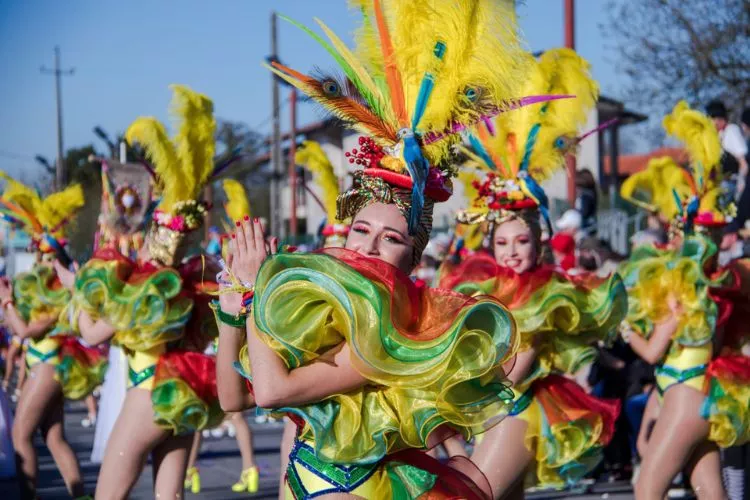
Carnival is a traditional and ancient celebration in Portugal, where it is still called “Entrudo,” as were the old traditions of celebrating the arrival of spring in the Northern Hemisphere. “Entrudo” (which means “entrance”) referred to religious calendar celebrations and was always marked by the spontaneity of the people, who would go out on the streets throwing water and eggs at each other.
Today, the Portuguese Carnival features parades with floats, samba dancers, people in costumes, cross-dressing men, masquerade balls, music, and lots of partying from north to south of the country. Does it sound familiar? Yes, in many ways, the celebrations in Portugal and Brazil can be quite similar. But there are also many differences, starting with the weather and the scale of the festivities, which are more modest.
Carnival Tuesday is not considered in the current Portuguese Labor Code (Law 7/2009, February 12) as a mandatory holiday. Unlike what happens in many Brazilian cities, where there is suspension of activities in schools and companies, in Portugal this routine is not altered. Because of this, parties usually take place at night and are more common on the weekend before Holy Wednesday.
In the northern hemisphere Carnaval takes place before the beginning of spring, so it is cold, even in the south of the country. The temperature is usually between 5 and 15 degrees. Even so, don’t be alarmed if you find scantily clad samba dancers dancing in the parades…
In 2026, Carnival Tuesday falls on February 17th.
The specific date of Carnival is a movable date, determined by the liturgical calendar of the Catholic Church. It is celebrated in the week before Lent, which is the week before Easter.
However, Carnival festivities in Portugal usually take place in the days leading up to Carnival Tuesday, especially on what is known as “Fat Sunday.”
Yes, there are many Brazilian style carnival parties that take place in Portugal, especially in cities with large communities of Brazilians, such as Lisbon and Porto. These parties usually include rhythms such as samba, frevo, and axé. With the growth of this population (today there are about 750 thousand immigrants from Brazil), the offer of events of this type is also increasing.
During the carnival season, festivities take place in several Portuguese cities and regions, each with its own tradition. Here are just a few of them:
In 2026, the Ovar Carnival starts earlier and takes place between January 24 and February 17, featuring more than three weeks of intense programming that combines tradition, street performances, major concerts, and strong involvement from the local community.
Arruada with Gigantones and Cabeçudos:
The official opening takes place on Saturday, January 24, with a large festive parade through the streets of the city center. The gathering begins at 10:00 p.m. in Praça da República, followed by an energetic procession led by Batucada Radical, ending with a show at the Municipal Market, presenting the spirit and image of Ovar Carnival 2026 with plenty of music and animation.
Arrival of the King Parade:
Scheduled for Sunday, February 1, in the city center, this symbolic moment traditionally marks the official beginning of the carnival reign; however, in 2026 it was canceled due to rain.
Carnival Corsos:
The two major parades of Ovar Carnival 2026 take place on Sunday, February 15, and Tuesday, February 17, starting at 2:30 p.m., along Avenida Sá Carneiro. The corsos feature floats, choreographies, and the full creativity of carnival groups and samba schools, and are considered the highlight of the festivities.
Night Parade of Samba Schools:
One of the most anticipated spectacles of the program, the night parade takes place on Saturday, February 14, at 10:00 p.m., on Avenida Sá Carneiro. Ovar’s samba schools parade with rhythm, color, and fantasy in an open-air visual and musical show.
Domino Night and Farrapada Parade:
The traditional Domino Night takes place on Thursday, February 12, at Espaço Folião, marked by humor, popular animation, and the irreverent spirit of carnivalgoers. The following day, Friday, February 13, features the Farrapada Parade, one of the most spontaneous and participatory moments of Ovar’s Carnival. In 2026, Domino Night once again features Quim Barreiros as one of the main musical highlights.
The musical program of Ovar Carnival 2026 once again combines national and international artists, spread across multiple stages and themed nights, ensuring entertainment for different audiences and musical styles.
Highlights of this edition include:
Another major highlight is the Grande Noite Mágica, which takes place on Monday, February 16, when the city center turns into a vast open-air party venue, with multiple stages, DJs, and concerts spread across different spaces, extending the celebration until dawn.
Events dedicated to different age groups continue to be an essential part of the Ovar Carnival. The Children’s Carnival takes place on Sunday, February 8, between 2:30 p.m. and 6:30 p.m., in the city center, bringing together hundreds of young revelers in a parade full of color, fantasy, and joy.
The Senior Carnival is scheduled for Thursday, February 5, from 2:30 p.m. to 6:00 p.m., at the Espaço Folião, providing an afternoon of music, dancing, and social gathering dedicated to the senior population.
As in previous editions, the organization reinforces its focus on safety and participant well-being, with specific planning for events with large crowds and programming designed for audiences of all ages.
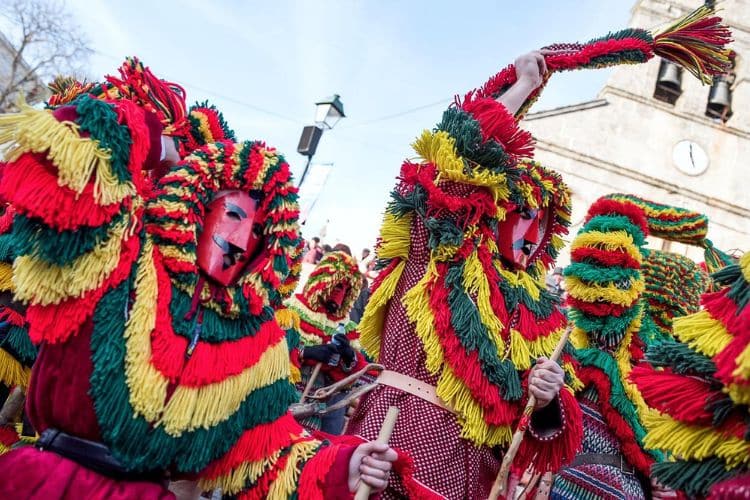
The small town of Macedo de Cavaleiros, located in Trás-os-Montes, preserves one of Portugal’s most ancient festivals, classified as Intangible Cultural Heritage of Humanity by UNESCO—a true delight for photographers worldwide.
The Carnival of Podence is marked by the image of the Caretos, young men dressed in colorful fringe costumes (red, yellow, and green), with pointed-nose masks and rattles around their waists. These rattles create the sound of the “chacoalheiro” carnival, which roams the streets of Podence with noise and irreverence on Domingo Gordo (Fat Sunday) and Carnival Tuesday. Disguised and protected by anonymity, the village boys embody these mysterious characters, jumping and shouting through the village, disturbing the peace and playfully chasing girls to dance and “rattle” them. The Caretos are traditionally associated with the figure of the “devil unleashed,” embodying the excesses allowed during this time of the year.
Another highlight of the Podence Carnival is the mock weddings—a humorous moment with no objections allowed from those chosen. Additionally, there are gastronomic nights, parades of marafonas (men dressed as women), and mask nights. On Carnival Tuesday, the parade and the Ceremony of the Burning of Entrudo take place, marking the end of the festivities.
For the full schedule of the Podence Carnival, check here (link to the official website).
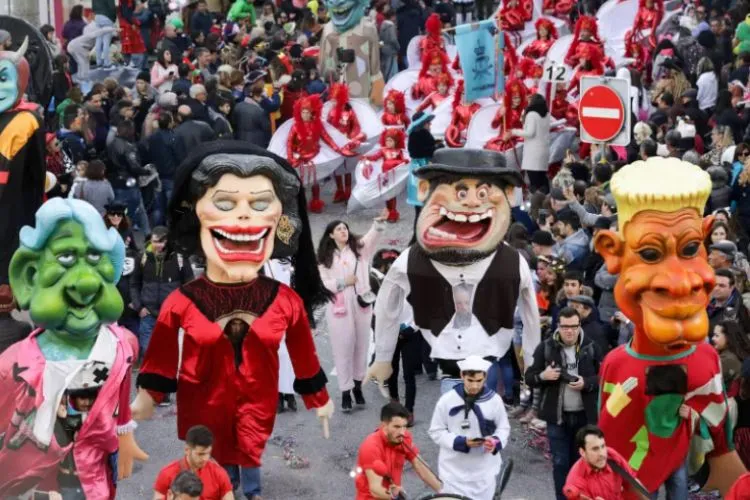
In 2026, the Torres Vedras Carnival, known as the most Portuguese Carnival in Portugal, returns to the city streets between February 12 and 18, this year under the theme “Mundo Encantado” (Enchanted World). Faithful to the traditions of the Entrudo, the celebration continues to rely on the spontaneous participation of thousands of citizens and maintains political and social satire as one of its strongest hallmarks.
Once again, the traditional floats take center stage. Built by local artists, these floats begin to be prepared months before Carnival and parade through the streets carrying messages of criticism, humor, and social satire, keeping the unique identity of the festival alive.
Other unmistakable figures of the Torres Vedras Carnival are the matrafonas, the cabeçudos, and the Zés Pereiras, elements deeply rooted in the local cultural heritage and which have also influenced Brazilian Carnival. The matrafonas are men dressed as women in a caricatured and irreverent way, interacting with the public and playing with everyday stereotypes.
The Zés Pereiras, in turn, are groups of musicians who play bass drums, bagpipes, and other traditional instruments, parading through the streets and sometimes accompanied by gigantones and cabeçudos. In recent years, the concertina, an instrument typical of the Minho region, has gained space within these groups, further enriching the soundscape of the celebration.
The gigantones and cabeçudos, present in Portuguese Carnival since 1935, resemble the giant puppets of the Carnival of Olinda, in Brazil. While the gigantones stand out for their imposing height, the cabeçudos draw attention with their oversized heads on small bodies. Initially made of papier-mâché, they are now produced using a variety of materials such as fabrics, plaster, and polystyrene.
The official 2026 program begins on February 12, with the Arrival and Enthronement of the Carnival Kings, whose parade departs from the railway station at 9:30 p.m., heading toward Avenida 5 de Outubro. The following day, February 13, the School Corso takes place in the morning, followed in the afternoon by the Traditional Masked Ball, held at Expotorres – Multiuse Pavilion. Over the following days, the city hosts parades, street entertainment, floats, and music in several locations, with highlights including Jardins de Santiago, the Municipal Market, and Praça Dr. Alberto Avelino.
The closing of the Torres Vedras Carnival takes place on Wednesday, February 18, at 9:00 p.m., with the traditional Burial of the Entrudo, a procession that runs between Avenida 5 de Outubro and the Torres Vedras Courthouse, symbolically marking the end of the celebrations.
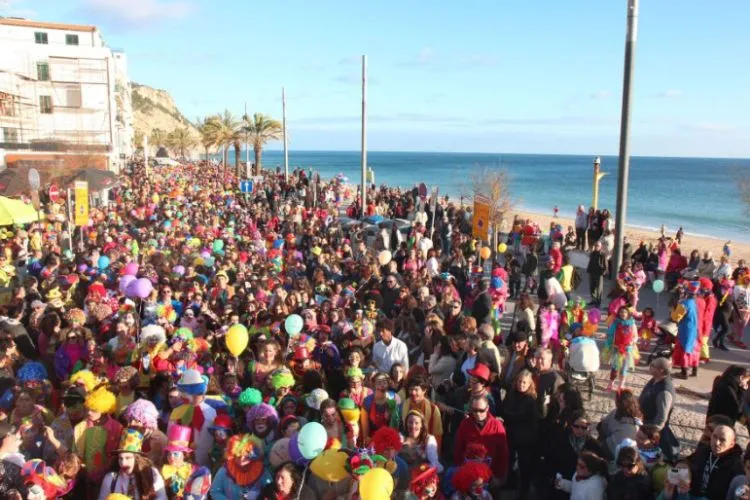
The city of Sesimbra, located in Setúbal, offers a carnival celebration in February and another one in the summer. Yes, that’s right! Both events take place by the seaside, featuring a parade stretching about one kilometer. Brazilian music sets the tone for both festivities.
In 2026, the Sesimbra Carnival takes place between February 7 and 18, with a diverse program that includes samba school parades, axé groups, costume contests, night balls, and traditional cultural expressions. The festivities begin with the Technical Rehearsal of the Samba Schools and Axé Groups, on Saturday, February 7, marking the official start of the celebrations.
The Marginal transforms into a stage for local samba schools, carnival groups, and thousands of revelers. The parade floats, bursting with color and decorations, captivate the audience with diverse themes, while dancers in stunning costumes perform choreographies rehearsed for months.
The event is meticulously organized, with each group or school receiving a set amount of time to showcase their storyline and performance. The competition among the associations is fierce, with judges evaluating the presentations based on criteria such as originality, quality of execution, and faithfulness to the chosen theme.
Beyond the samba schools, ancient local traditions are also celebrated:
The Loulé Carnival returns on February 15, 16, and 17, with three days of parades along the Loulé “sambadrome,” the oldest carnival corso in the country. In 2026, the theme is “Super Carnival,” bringing superheroes and villains to the avenue in a parade marked by political, social, and sports satire.
The parade begins at 3:00 p.m. and features 13 floats, more than 600 performers, samba schools, gigantones, entertainment groups, and a DJ, in a spectacle that combines humor, creativity, and social criticism. Zé Povinho takes on the role of the main hero of this edition.
With tickets priced at €2, the Loulé Carnival maintains its charitable aspect, with proceeds directed to associations and social causes. The celebration is accompanied by parallel activities, such as the traditional Gala Ball, and in 2026 it is a finalist of the Iberian Festival Awards.
For more information about the Loulé Carnival 2025, click here.
In addition to these, there are celebrations in many other cities, including Funchal and Santa Cruz (Madeira), Nazaré, Viana do Castelo, Sines, Alcobaça, Estarreja, Vale de Ílhavo, Famalicão, in addition to Lisbon and Porto.
Driven by the growing Brazilian presence in Portugal, the agenda of Carnival balls and street blocks in Lisbon continues to expand. From maracatu to traditional marchinhas, passing through samba, funk, and axé, there are attractions for all tastes in the Portuguese capital. The city has the largest concentration of organized Carnival blocks.
In 2026, Lisbon will have 17 blocks parading during Carnival. Here are some of them.
Bloco Cuiqueiros de Lisboa:
Founded in 2022, it arrives at Carnival 2026 with regular rehearsals and around 30 to 40 members in the percussion section. The group parades in different formats, including a procession at São Jorge Castle, as well as performances in Ovar and in the Algarve. The event takes place on February 12, at 2:30 p.m., at the Chapitô circus school.
Bloco Baque do Tejo:
Maracatu in Lisbon? Yes. The procession of the Baque do Tejo group is marked by the spirit of Pernambuco. Baque do Tejo takes part in Lisbon’s pre-Carnival on January 17, 2026, with a large procession that starts on the street and continues to the Fábrica Braço de Prata, bringing together different blocks, a frevo concert, and DJ sets. For Carnival itself, the program has not yet been announced.
Bloco Colombina Clandestina:
The group is a non-profit collective that believes in the collective construction of Lisbon’s Carnival. It is considered the largest street Carnival block outside Brazil. The event is expected to take place on February 14, departing from Espaço Casa Capitão.
Lisbloco:
Founded in 2020, this Carnival block follows Brazilian models and is made up of musicians and dancers living in Lisbon, adopting a theme of environmental awareness. Its sound includes rhythms such as samba, marchinhas, samba-reggae, xote, and frevo, and the group promotes musical workshops throughout the year.
Carnaval Bué Tolo:
The name was inspired by the famous Rio de Janeiro block Boi Tolo. In Lisbon, the block will once again hold its pre-Carnival on February 14, 2026, at Village Underground (Av. da Índia, 52), from 3:00 p.m. to 10:00 p.m., with free admission. The traditional procession through the streets of Cais do Sodré, which usually takes place on the Saturday before Carnival, has not yet been officially confirmed. In addition to the pre-Carnival rehearsal, the group also usually holds a procession through the streets of Cais do Sodré on the Saturday preceding Carnival. This procession is only confirmed shortly before Carnival.
Carnival at the Queluz Palace, Sintra:
For adults and children, featuring a mask-making workshop followed by an immersive experience in which participants, accompanied by characters dressed in period costume, actively take part in an eighteenth-century music and dance experience in one of the palace’s historic ballrooms. Takes place on February 15 and 17, with tickets priced at €17 (adults) and €12.50 (children). Children under 5 years old enter free of charge.
Bloco Cuiqueiros de Lisboa:
Founded in 2022, it arrives at Carnival 2026 with regular rehearsals and around 30 to 40 members in the percussion section. The group parades in different formats, including a procession at São Jorge Castle, as well as performances in Ovar and in the Algarve.
Bloco Secretinho:
In addition to parties on February 1 and 8, at the Fábrica, the group promotes its procession at Parque Ribeirinho Oriente on February 15, from 2:00 p.m. to 9:00 p.m.
Event: Bloco Secretinho Carnival
2:00 p.m. – Gathering at Parque Ribeirinho Oriente, Marvila
3:00 p.m. – Bloco Secretinho procession to 8 Marvila
4:30 p.m. – Pirâmide concert at 8 Marvila
5:30 p.m. – Bloco Secretinho concert at 8 Marvila
7:30 p.m. – DJ Set SAPATRUX at 8 Marvila
🎟 Free event. Free entry.
🗓 February 17, 2026
Event: Patú Sambá Samba Circle
⏰ 4:00 p.m. to 7:00 p.m.
📍 Fábrica Braço de Prata
🎟 Pay-what-you-can entry

Portugal’s second-largest city also celebrates Carnival with street parades and parties. The festivities take place mainly on the weekend preceding Carnival Tuesday.
WOW (World of Wine) in Vila Nova de Gaia celebrates Carnival 2026 between February 15 and 17. Highlights include Carnavrau on February 15 and Samba do B on February 16, as well as gastronomic experiences at VP (Venice Carnival) and at 1828 (Carnival Dinner).
February 15 (Carnavrau): Party at Lemon Plaza (4:00 p.m.–12:00 a.m.) with Brazilian music, samba, and DJs.
February 16 (WOW Sessions Carnival): Samba with the group Sambadob, at Lemon Plaza.
Some of the city’s best dance floors are also part of the celebrations. Be sure to check the programs at venues such as Pérola Negra, Plano B, Lust, Gare, and Maus Hábitos.
In the streets of Porto, the traditional parade of the Batucada Radical group takes place once again, bringing energy to the city in 2026 with dozens of percussionists, a mini electric trio, and plenty of excitement. With support from the Porto City Council, Ágora, and the Bonfim Parish Council, the procession takes place on Sunday, February 15, under the direction of Mestre Porto, starting at 3:00 p.m. on Rua do Heroísmo, in front of the Stop Shopping Center, and heading toward Fontainhas.
This year’s parade carries the theme “Porto is not a place, it is a feeling,” an iconic phrase by writer Agustina Bessa-Luís, and promises an open and participatory celebration, featuring marchinhas, samba, axé, frevo, forró, funk, Portuguese music, and sounds from around the world, inviting the public to dress up and celebrate Carnival in the city streets.
Mercado do Bolhão hosts a free Carnival event on February 12, 13, and 14, from 1:00 p.m. to 12:00 a.m., with more than 10 attractions and musical programming throughout the day, in the heart of Porto. The event takes place on Rua Formosa, in one of the city’s most iconic spaces.
Access is free, but consumption at the bars will be exclusively with the official event cup, available through the purchase of the Ticket + Cup, valid for all days. The price is €3 with the donation of 1 kg of food or €5 without food. In case of full capacity, priority entry is given to participants who purchased tickets in advance.
If you are looking for a different sound but still want to get into the Carnival spirit, Hard Club offers a direct trip back to the 1990s in a night that breaks away from the obvious. On February 16, starting at 11:30 p.m., the iconic Mercado Ferreira Borges hosts a Carnival party dedicated to the music and aesthetics of the last decade of the twentieth century.
Amid masks, glitter, and costumes inspired by bands such as Nirvana, Pearl Jam, and Guns N’ Roses, the night will be driven by the band Noventamente and DJ Tatá Pimentel, guiding the audience on a nostalgic sonic journey, blending rock, attitude, and Carnival spirit.
Some of Porto’s best dance floors are also part of the celebration. Don’t miss the programs at popular venues like Pérola Negra, Plano B, Lust, Gare, and Maus Hábitos.
The Carnival of Porto reflects the cultural richness and vibrant energy of this city, blending Portuguese traditions with international influences, offering a unique experience for both residents and tourists. If you are considering relocate to Portugal or obtaining Portuguese citizenship, seize the opportunity to live in a place where culture and fun go hand in hand. Atlantic Bridge is ready to help you make this dream a reality, offering personalized services for the citizenship and residency process.
Contact us and start your journey towards a new life in Portugal!